
There have been several responses to the first mini-album Ornaments, and in 2026 — even though I released two projects — Fragments remains the record that best represents this year.
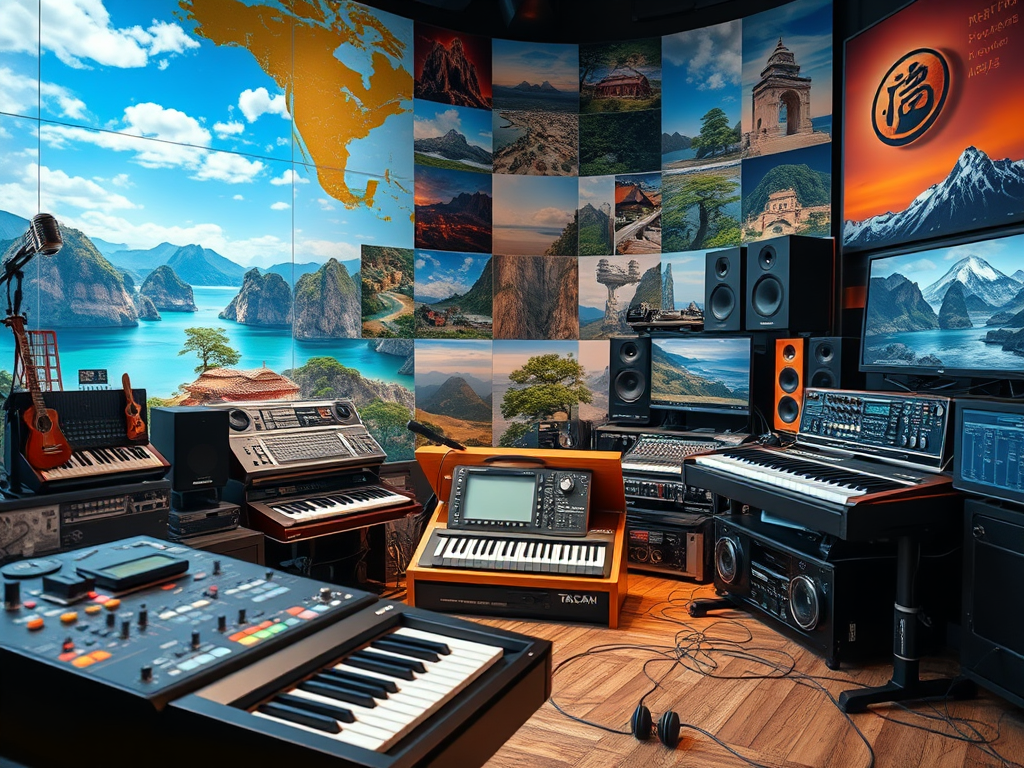
Regarding the recording process, I’ve captured sounds in various places around the world. I’m currently sorting through them and transferring everything into the Tascam, with the idea of possibly using a module that handles sampling and binary triggering across two drum racks. This would require careful work on the organic aspect of the material, selecting only sounds of roughly one minute in length. From these, I’ll be able to extract harmonies for pads or create a form of ring modulation using the dual VCO already integrated into my modular synthesizer.
Through adjustments of decay and attack settings, these sounds can form a kind of organic rack, shaped primarily through the Prism module acting as a filter. Within these tracks, there will also be the possibility of generating evolving textures using different impulses, managed through an envelope follower.
I’ve recently started posting more videos again on YouTube, and I’ve shared some on TikTok and Instagram as well. That said, YouTube remains my preferred platform, even if TikTok reaches a larger audience. In any case, that’s not the most important thing.
The track Luminaire is truly beginning to emerge. Much like Erosione from the mini-album Fragments, and in relation to Ornaments with the piece The Fade That Never Ends, this new title feels deeply anchored in my memory — both lyrically and in the way it is performed. I can easily imagine performing a concert built solely around these three pieces.
Still, the immense pleasure and intention behind performing new recordings always pass through a certain emotional connection to a previously recorded song — one that remains entirely alive in the present moment. For that reason, I’m considering releasing one recording per year, varying the formats while maintaining the same visual identity — with the symbolic importance of the number three — and, of course, continuing the concept of integrating the guitar directly into the modular system as an essential part of the overall corpus.
I’ve also experimented with voice processing using the Larchd module, which has produced some interesting textures. It allows for real-time manipulation, avoiding the more static setup of a microphone combined with the Strymon DIG dual delay pedal.
In terms of inspiration, Taoism remains central to my thinking and to the way I work and live daily. I’ve explored other spiritual paths, but Taoism remains the primary source of inspiration. I continue deepening my practice through texts I own in multiple languages — English, Italian, and Spanish — to refine my understanding, particularly of concepts such as non-action.
There have been positive responses that I’ll be able to reference directly on the website, including press mentions and blog features covering recent releases. There are also discussions of several potential concert dates, but for now I prefer to continue developing certain aspects more fully.
In today’s world — and personally through a significant life transition — I’ve managed to carry forward the essence of what I was living before, even after changing my living space. I’ve condensed what truly nourishes me into a more compact environment. Changing places always allows for a necessary sorting process — keeping what matters most while maintaining a strong awareness of the inner work already accomplished.
Life is extraordinary in that we learn a little every day. Last Friday, I crossed paths with Lionel Fox, a legend of 1970s acid psychedelic music. We had a great conversation, and I was genuinely happy to meet him. I think I’ll speak about that encounter in the next podcast — it will certainly be one of the topics discussed.
 Zi iacchos
Laisser un commentaire