
In any kind of work—especially when you have personal expectations based on what you’ve done in the past, along with new demands—there’s always a big difference between what you imagine, what you work on theoretically, and what you actually create and bring into reality. It’s a real challenge, especially when you’re focused on the details and aiming for a certain level of success. All of this makes it important to be able to finish things in the best conditions possible, so that you don’t have any regrets later on.
The first song of this new project is taking a lot of work and time. Even though you can’t really choose the timing when it comes to inspiration—since the creative and production process can often only happen in a single moment—consistent work is truly what matters most.
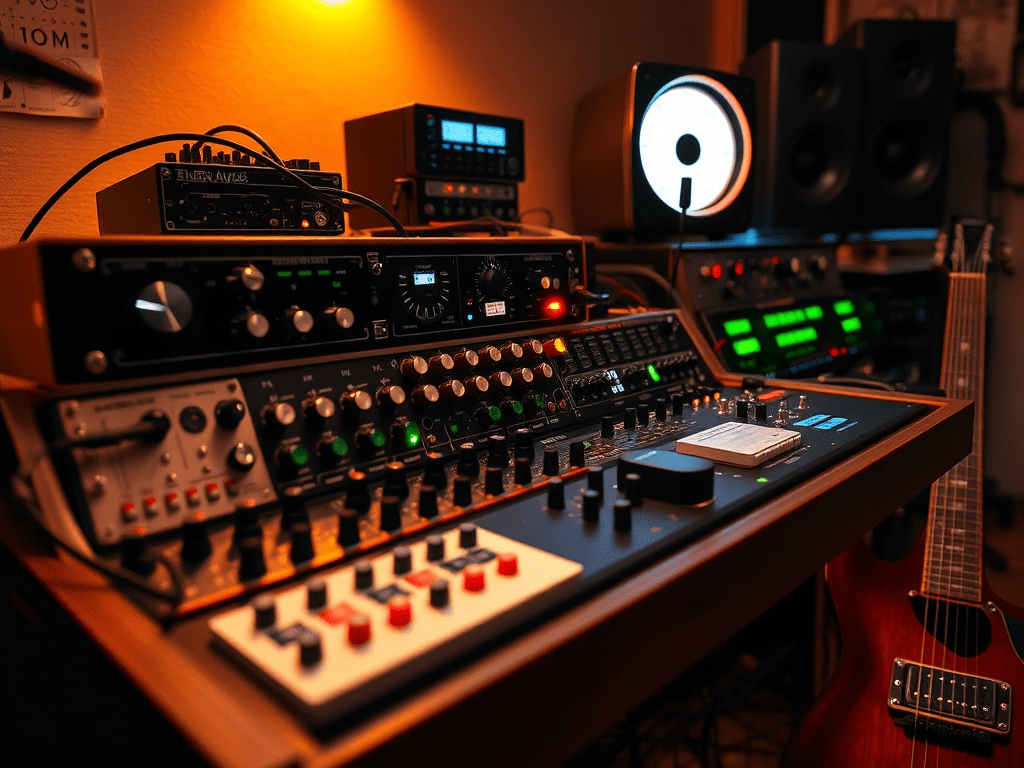
As for the modular rack, I’ve gone with a synthesis approach that focuses mainly on LFOs. I’ve left out envelope generators because integrating the guitar into the system already allows it to generate its own kind of envelopes—unconventional ones, sure, but different in a good way. Using both standard envelopes and these guitar-driven ones just adds a layer of complexity that, in the end, takes away from the fun and makes structuring things feel like a chore.
So, I’m now using the TSL module by Instruō as my main clock, and I’ve removed the Cascade envelope to replace it with the Clep Diaz module from Noise Engineering. There are some modules, no matter their function, that you just connect with on an emotional level—they help you express something inside. I’ve often felt that with the Viol Ruina from Noise Engineering, the Tahn from Instruō (which I now use as a preamp), and the dual VCO from Zlob Modular. That VCO may not have tons of features, but it has a unique tone—whether it’s the sine wave or something else—and I’d even say it gives off a kind of ring modulation vibe on the output. When paired with the Prism module (which plays around with bit crushing and comb delay), you get these rich, crunchy textures.
So by only using LFOs for clocks and modulation, I’m able to synchronize everything while still keeping a sense of freedom—and that’s exactly what I had been missing these last few months. I also switched back to recording in Adobe Audition because Ableton was holding me back in a lot of ways. I think Ableton is better suited for live performance or loop-based work, but working in rectangles and needing to be rhythmically perfect just isn’t my thing. I’ve been thinking a lot about that in relation to my past projects—how that unexpected freedom can spark creativity and lead to some really surprising and amazing results. It helps open the door to new ideas and deeper inspiration.
The first track, « Ornaments », is progressing well. The lyrics I started writing in Slovenia are about 75% done. It’s a real pleasure to be able to work with the guitar directly integrated into the modular setup. That said, I think I’ll always do two main tracks: one with the rack—kind of a sequenced blend of experimental and ambient textures, though not too ambient, because I want to avoid that overly obvious aesthetic—and a second track that also uses the modular/guitar integration, but with the phaser added and routed through the Prism module to reflect the core idea. Then finally, a third vocal track over everything.
It’s possible I’ll only release one or two tracks this year, but they’ll serve as a vital foundation—something that will shape and enable countless creative directions for the years to come.
Zi
 Zi iacchos
Laisser un commentaire