
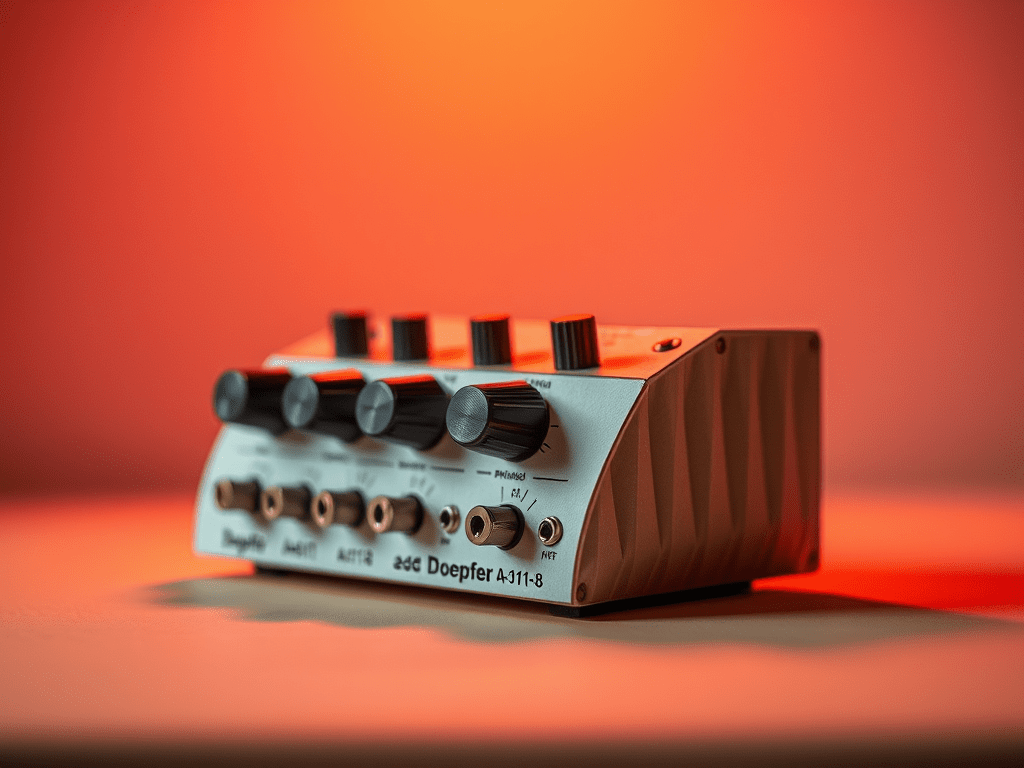
It all starts with a single note on the guitar. The strings vibrate, the signal travels, and before it reaches its final destination, it embarks on a transformation—a journey through space and texture, shaped by the Doepfer A-101-8 Phaser, twisted by the Qu-Bit Prism, and given a heartbeat by Cascade.
The Phaser: A Moving Foundation
The A-101-8 is a phaser unlike any other. Inspired by vintage designs, it breathes movement into a static note, shifting its harmonic structure in a way that feels organic and alive. But on its own, it’s just waiting—waiting for something to bring it to life. That’s where the Tš-L steps in.
Set in LFO mode, the Tš-L isn’t just a modulation source—it’s the pulse behind the movement. Feeding a triangle wave into the phaser’s CV input makes the phase shift ebb and flow naturally, while the PWM output adds erratic, unpredictable sweeps, as if the signal is bending in and out of reality.
With the mix knob carefully balanced, the original guitar tone and the modulated signal merge into something spectral, something beyond a simple effect. The phaser now breathes, responding to its own swirling modulation.
Stepping Into the Echo Chamber
The Prism comes next, its filter disabled to let the echoes shine through. Instead of shaping the tone, it stretches it—pulling the phased sound into rhythmic repeats that trail off like distant memories. The two delay modes offer distinct flavors: a tight slapback for punchy, rhythmic textures, or a longer, evolving echo that turns each note into a wave washing over the mix.
Then comes Freeze—a secret weapon. With a tap, a moment in time is captured, looping infinitely. A single note phasing, repeating, shifting subtly as new layers weave in and out. It’s no longer just an effect; it’s a soundscape being built in real-time.
The Missing Link: Cascade
Something is still missing—a sense of connection, of responsiveness between the player and the machine. That’s where Cascade finds its purpose.
At first, it acts as a preamp, bringing the guitar’s signal up to modular level. But then, the real magic begins. Set in envelope follower mode, Cascade listens, reacts. When a chord is struck hard, it modulates the delay time on the Prism, causing echoes to stretch and contract in response to playing dynamics. The whole patch suddenly feels alive, responding not just to knobs and CV but to the energy behind the notes.
With a little tweaking, Cascade also feeds back into itself, creating a subtle compression effect that tightens the sound just enough to keep it all balanced. The phaser swirls, the delay expands, and the entire setup breathes in sync with the player’s touch.
The Sound of Exploration
This isn’t just a patch—it’s an instrument. It reacts, evolves, and invites the player to push it further. Subtle phase shifts turn into resonant sweeps, echoes morph into rhythmic pulses, and every nuance of the performance is woven into the sound itself.
This is what modular is about: sculpting sound, chasing modulation, and finding inspiration in the unexpected. And at the heart of it all? A single note, waiting to be set in motion.
Zi
 Zi iacchos
Laisser un commentaire