
For an album with a specific theme and especially mixed influences — ranging from books to certain albums that don’t directly relate to my final work — I was exploring some ideas. This led me to a unique recording setup, not just field recordings but more of a guitar sampling approach. The goal was to create original textures and have a blast recording them. I have two Earthquaker Devices pedals: the Transmisser and the Time Shadows v1. At one point, I decided to sell almost all my pedals, going from around ten to just four now, including the truly impressive Freeze pedal from Electro-Harmonix.
The current recording session is for an album called Aquatic Archetypes. I’ve planned three tracks, one of which was completely unplanned. It emerged because I forgot to plug in the jack from my favorite effect pedal, the Strymon Dig Dual Delay. This created a moving drone effect due to the unplugged jack, and I found myself spontaneously using this natural “glitch,” tweaking the various buttons, rhythms, sound textures, and delay types. This allowed me to capture sounds and textures, which I plan to slice and later use to create pads or synth sounds in Ableton, transformed chromatically with a keyboard.
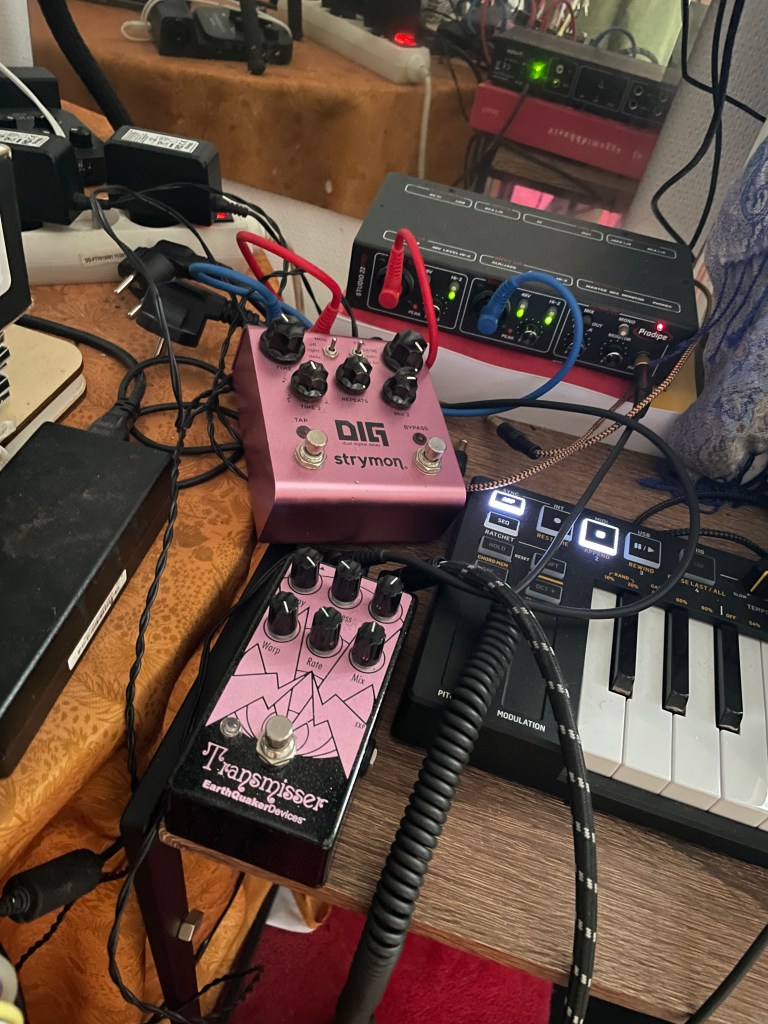
The other two tracks focus on the Transmisser — with its enveloping reverb and wrap filter that consumes the sound entirely — and the Time Shadows, which offers three different functions, including a hidden one. The setup is about chaining one of the EQD pedals into the Strymon Dig and running the stereo output into my audio interface. In Ableton, this stereo signal is recorded on two separate stereo tracks, allowing for a back-and-forth effect, like a ping-pong delay, that can be saved as a sort of homemade synth bank. The Strymon Dig serves as a stereo router, letting me process the sound further with envelope filters and different features in Ableton, which will make reproducing these sounds simple in concert. The plan is to handle these sounds with a MIDI keyboard, laying down one of the foundational layers of the recording, set for release in 2025.
For capturing sequences with effects, I used my only electric guitar. It brings a structured resonance that an acoustic guitar wouldn’t quite provide, helping retain a complete sound.
A second interesting aspect is incorporating an acoustic guitar directly into the modular system. Some modules accept audio inputs, so I tested it with the A*B+C module by Befaco and the FX Aid multi-effect. The Befaco module was a better fit for this, as it works as a mixer and attenuator, among other things. The idea is to use the midi keyboard with these constructed sounds from effects and the electric guitar, while integrating the acoustic guitar into a module with an audio input, allowing me to mix everything without lots of complicated patching. Additionally, the SQ-1 sequencer from Korg, with its note function, enables key and scale changes, allowing each track to connect to a VCO.
The primary goal is to rehearse and perform these tracks live, ensuring they’re stable bases, not just impressive recordings that are difficult to recreate. I’m using small notes posted around the workspace to keep ideas on track and move forward practically.
Zi
 Zi iacchos
Laisser un commentaire